Beginner · Technical intensive · DOC-THM-03

Thermal Reality

Air Containment, Chilled Water & Liquid Cooling Operations

Read the cooling plant as one connected heat-rejection path from server cold plates and contained aisles through CRAHs, CDUs, chilled-water headers, and outdoor economizers.

Start Lesson 1 (~16 min open)
Open sample & effort
All 5 browser lessons & capstone open free (~85 min reading; no login).
Prerequisites
The Critical Floor or basic familiarity with temperature, pressure, and data center hall layouts. Heat-transfer math is explained step by step. Designed for: Mechanical & HVAC specialists, shift operators, facility technicians, and liquid-cooling operations teams.
Tuition & cohort enquiry ($399 · $1,600 list)

Course outline · 5 open browser lessons (~85 min reading)

  1. 01Heat, airflow, and aisle containment~16 min read
  2. 02CRAHs, chilled-water plants, and wet-bulb rejection~18 min read
  3. 03ASHRAE envelopes, dew point, and thermal ride-through~16 min read
  4. 04Liquid cooling, CDUs, and hybrid halls~18 min read
  5. 05Thermal alarms, strainer ΔP vs leaks, and response~17 min read

Plus 1 unmeasured end-of-course capstone check and self-paced DOC-THM-03 deliverable rubric in the open studio below.

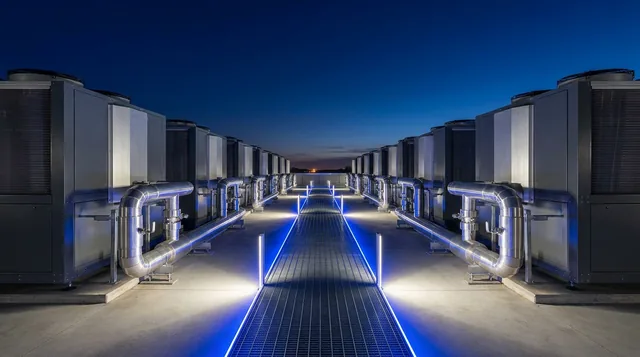
Twilight architectural view of hyperscale chilled-water headers and free-cooling heat-rejection chillers
FIG. 01 · DOC-THM-03Air Containment, Chilled Water & Liquid Cooling Operations
Prerequisites
The Critical Floor or basic familiarity with temperature, pressure, and data center hall layouts. Heat-transfer math is explained step by step. Designed for: Mechanical & HVAC specialists, shift operators, facility technicians, and liquid-cooling operations teams.
Study scope
Open now: ~85 min approximate reading across 5 interactive browser lessons (16 to 18 min each). Self-paced & unmeasured: end-of-course capstone check, paired Campus Shift exercise, and drafting your DOC-THM-03 deliverable. Extended cohort scope: 8 hours extended syllabus & project scope.
Deliverable
Portfolio deliverable: A thermal-chain diagnostic map with control points, dew-point limits, and escalation triggers. (DOC-THM-03)
Tuition & enquiry
$399 self-paced tuition ($1,600 list). All 5 lessons below are already open free; submitting the enquiry form records your email for manual follow-up with no online card checkout or gated account login.
Progress & terms
6/6 lesson and capstone checks save in this browser (localStorage with session fallback). Independent professional-development training, not an accredited certificate/degree, trade license, vendor credential, or live-site switching authorization.
Paired Campus Shift mission
35 kW Hot/Cold Aisle Containment Balance (free interactive Campus Shift in browser)
Recommended next course
Signal Room: Recommended next when you’re comfortable with both power and cooling fundamentals (relevant experience counts): learn how BMS and EPMS screens report plant state, and when a sensor reading can mislead you. Branched here straight from The Critical Floor? If you’re new to 2N switchgear and UPS bypass paths, consider taking Utility to Rack before Signal Room so 1 ms EPMS breaker and UPS telemetry have context (optional; relevant electrical experience counts).
Scope note & primary engineering references (3 cited)

Open browser lessons total ~85 min approximate reading across 5 modules; the end-of-course capstone check, paired Campus Shift exercise, and self-paced DOC-THM-03 deliverable draft are separate unmeasured practice outside the extended cohort scope (8 hours extended syllabus & project scope).

  • ASHRAE Handbook: HVAC Applications Ch. 20 & TC 9.9 Thermal Guidelines (Classes A1 to A4 and H1 equipment-inlet envelopes, Table 1 note [n] conditional 50%/70% RH corrosion limits, and W17 to W45 liquid classes)
  • Open Compute Project (OCP) Cold Plate & Liquid Cooling Facility Guidelines (coolant chemistry, multi-stage filtration, and dew-point condensation margin)
  • ASHRAE Datacom Series (containment differential pressure, psychrometrics, and chilled-water thermal energy storage ride-through)

Interactive self-paced studio

Study Thermal Reality right now, at your own pace.

Self-paced progress · 0/6 checkpoints verified
Lesson 1 of 5 · ~16 min studio (90 min syllabus scope)

Heat, airflow, and aisle containment

Key terms defined in plain language first
Static Differential Pressure (ΔP, Pascals)

The tiny air-pressure cushion (often +2.5 to +12 Pa) maintained inside a contained cold aisle relative to the hot return space.

Positive ΔP gently pushes air outward through seams; if ΔP goes negative, servers suck ~38°C hot exhaust backward into cold intakes!Encyclopedia: Differential Pressure (Delta-P / ΔP)
Bypass Air vs Recirculation Air

Bypass air is cold CRAH supply escaping straight to return without cooling any server; recirculation air is hot server exhaust looping back into cold intakes.

Bypass wastes fan energy and starves aisles; recirculation causes sudden top-of-rack inlet temperature spikes.Encyclopedia: Exhaust Air Recirculation
Actuator Saturation (100% Valve / Fan)

When a chilled-water (CHW) control valve or Variable Frequency Drive (VFD) / electronically commutated (EC) fan controller has already reached 100% physical output.

Lowering a digital temperature setpoint on a 100%-saturated CRAH produces zero extra cooling; you must check upstream water flow/temp or bypass leaks.Encyclopedia: Actuator Saturation (100% Output) and Control Loop Hunting
Field engineering briefing

Air cooling fails in two completely different ways that look identical on a single rack temperature alarm: either the mechanical plant lacks cooling capacity, or plenty of cold air is leaving Computer Room Air Handlers (CRAHs) while bypass leaks and recirculation traps stop it from reaching server intakes. Reading static pressure and actuator percentages separates an airflow problem from a plant problem.

Static pressure balance, bypass/recirculation traps, blanking panels, VFD cube-law fan power, and aisle ΔT.

Matching CRAH supply CFM to server fan demand

Every server runs internal variable-speed fans that demand more cubic feet per minute (CFM) or m³/h when compute load or inlet temperature rises. To keep top-of-rack switches fed cleanly, CRAH supply airflow into a contained cold aisle must slightly exceed total server fan demand, preserving a small positive differential pressure (+2.5 to +12 Pa).

Why blind setpoint drops fail when actuators hit 100%

Operators on the Building Management System (BMS, which polls field controllers over protocols such as BACnet) are sometimes tempted to lower a CRAH setpoint from 20°C to 17°C when a Resistance Temperature Detector (RTD) air probe warms up. Always check valve command (%) and fan speed (%) first: if the unit's proportional-integral-derivative (PID) control loop has already driven both to 100% while discharge air climbs to 28°C, the actuator is physically maxed out, pointing upstream to warm CHW supply, low loop differential pressure, or air-bound coils.

System state-change diagram

Cold-Aisle Pressure Starvation vs Saturated CRAH Coil

Viewing: 2. Trigger: GPU/CPU Fans Surge · ΔP Drops to -4.5 Pa
Swipe sideways on narrow screens · Node values below
Cold-AisleDifferential ΔP-4.5 Pa! (Suctioninward)CRAH-4A Supply Air &Valve20.1°C · Valve 64%(Not maxed)CRAH-4A EC Fan SpeedLagged at 68% onreturn RTDTop-of-Rack Inlet(U40)29.6°C (Hot seambackflow)
  1. 1. Cold-Aisle Differential ΔP-4.5 Pa! (Suction inward)
  2. 2. CRAH-4A Supply Air & Valve20.1°C · Valve 64% (Not maxed)
  3. 3. CRAH-4A EC Fan SpeedLagged at 68% on return RTD
  4. 4. Top-of-Rack Inlet (U40)29.6°C (Hot seam backflow)

Compare two warm-aisle causes: Case A (negative ΔP airflow starvation with cool 20°C CRAH supply) vs Case B (100% saturated CHW valve).

Accessible text walkthrough & 3-state comparison table

When server fans surge faster than CRAH fans, cold-aisle pressure drops from +5.0 Pa to -4.5 Pa and pulls hot exhaust into U40 (29.6°C) even though CRAH discharge is 20.1°C at 62% valve; ramping CRAH fans restores +5.2 Pa and 21.8°C inlet.

System node1. Balanced Cold Aisle (+5.0 Pa)2. GPU/CPU Fans Surge · ΔP Drops to -4.5 Pa3. CRAH ΔP Control Ramps Fans · +5.0 Pa Restored
Cold-Aisle Differential ΔP+5.0 Pa (Outward seal)-4.5 Pa! (Suction inward)+5.2 Pa (Positive restored)
CRAH-4A Supply Air & Valve20.1°C · CHW Valve 62%20.1°C · Valve 64% (Not maxed)20.2°C · Valve 74%
CRAH-4A EC Fan Speed68% commandLagged at 68% on return RTD84% via aisle ΔP trim
Top-of-Rack Inlet (U40)21.6°C29.6°C (Hot seam backflow)21.8°C (Clean cold feed)

When server fans surge faster than CRAH fans, cold-aisle pressure drops from +5.0 Pa to -4.5 Pa and pulls hot exhaust into U40 (29.6°C) even though CRAH discharge is 20.1°C at 62% valve; ramping CRAH fans restores +5.2 Pa and 21.8°C inlet.

  • Cold-Aisle Differential ΔP: Balanced Cold Aisle (+5.0 Pa) = +5.0 Pa (Outward seal); GPU/CPU Fans Surge · ΔP Drops to -4.5 Pa = -4.5 Pa! (Suction inward); CRAH ΔP Control Ramps Fans · +5.0 Pa Restored = +5.2 Pa (Positive restored).
  • CRAH-4A Supply Air & Valve: Balanced Cold Aisle (+5.0 Pa) = 20.1°C · CHW Valve 62%; GPU/CPU Fans Surge · ΔP Drops to -4.5 Pa = 20.1°C · Valve 64% (Not maxed); CRAH ΔP Control Ramps Fans · +5.0 Pa Restored = 20.2°C · Valve 74%.
  • CRAH-4A EC Fan Speed: Balanced Cold Aisle (+5.0 Pa) = 68% command; GPU/CPU Fans Surge · ΔP Drops to -4.5 Pa = Lagged at 68% on return RTD; CRAH ΔP Control Ramps Fans · +5.0 Pa Restored = 84% via aisle ΔP trim.
  • Top-of-Rack Inlet (U40): Balanced Cold Aisle (+5.0 Pa) = 21.6°C; GPU/CPU Fans Surge · ΔP Drops to -4.5 Pa = 29.6°C (Hot seam backflow); CRAH ΔP Control Ramps Fans · +5.0 Pa Restored = 21.8°C (Clean cold feed).
Worked engineering example

Sensible air-flow math and actuator saturation check on Cold Aisle 2

Given scenario

Illustrative aisle calculation: Contained Cold Aisle 2 carries 360 kW of air-cooled servers designed for a 12.0°C server chassis temperature rise (ΔT_air = 12.0°C, from 21.0°C inlet to 33.0°C exhaust; air volumetric heat capacity ρ·c_p ≈ 1.20 kJ/m³·°C at sea level).

  1. Step 1

    Calculate minimum server airflow demand with units: Using Q = V_dot × ρ·c_p × ΔT, V_dot_servers = 360 kW ÷ (1.20 kJ/m³·°C × 12.0°C) = 25.0 m³/s (~53,000 CFM).

  2. Step 2

    Size CRAH aisle delivery for slight positive ΔP (~5% seal margin): CRAHs in Aisle 2 must deliver ~25.0 × 1.05 ≈ 26.3 m³/s (~55,650 CFM). Delivering only 22.0 m³/s forces 3.0 m³/s of 33°C hot exhaust to recirculate backward into top-U intakes.

  3. Step 3

    Check saturated-coil trap: If CRAHs already show Fan = 100%, CHW Valve = 100%, and Discharge Air = 27.9°C, typing a 17.0°C setpoint adds 0 m³/s and 0 kW; check central chilled-water supply temperature and header ΔP immediately.

Operational takeaway: Check CHW Valve %, Fan %, Discharge Air °C, and Aisle ΔP (Pa) together; those four numbers separate airflow starvation from chilled-water shortage in under thirty seconds.
Optional depth · Scope boundaries & modeling assumptions

Scope & assumptions: Air density ρ decreases significantly at high-altitude sites (e.g., Denver/Johannesburg require ~15% to 20% higher volumetric m³/s / CFM per kW), and target ΔP (+2.5 to +12 Pa) varies by containment construction.

Optional reference table · DOC-THM-03: Airflow & Containment Diagnostic Layer

Maps air-side control loops and actuator saturation checks for the DOC-THM-03 cooling-path deliverable.

FieldIllustrative entryVerification rule
Contained Aisle ΔP Sensor+5.0 Pa cold-to-hot differential (site band +2.5 to +10.0 Pa).Negative ΔP indicates server fan demand exceeds CRAH delivery or containment door is open.
CRAH Coil & Fan HeadroomDischarge air 20.2°C; CHW 2-way control valve at 64%; EC fan array at 71%.If valve = 100% and discharge air climbs, check CHW loop ΔP and supply water temp; do not drop air setpoint.
Rack ΔT Sanity CheckServer inlet 21.5°C to rear exhaust 33.5°C (12.0°C chassis ΔT).Top-U inlet > 4°C warmer than bottom-U on same rack signals hot-air recirculation.
Operator field checklist (check off as you review)
Graded checkpoint · Counts toward 6/6Module 1 of 5 verification

When a CRAH's chilled-water valve and fans are already physically at 100% command with discharge air at 27.9°C, what does lowering its digital supply setpoint from 20.0°C to 17.0°C accomplish?

During an afternoon heatwave, Cold Aisle 2 climbs to 30.8°C. Pulling up CRAH-2A and CRAH-2B on the BMS, you see both units already have Chilled-Water Valve Command = 100%, Fan Speed = 100%, and Discharge Air = 27.9°C against a 20.0°C setpoint. A junior operator suggests lowering the BMS supply-air setpoint from 20.0°C to 17.0°C to cool the aisle down.

Lesson 1 of 5 · Open browser studio

Capabilities

What you will verify on shift.

  • Explain hot/cold aisle containment, static pressure differential, fan affinity laws, and ASHRAE psychrometric envelopes
  • Trace chillers, primary/secondary pumps, thermal storage ride-through tanks, and wet-bulb economizer approach limits
  • Distinguish rear-door heat exchangers, liquid-to-air CDUs, and liquid-to-liquid direct-to-chip loops
  • Diagnose fouled strainers vs true coolant leaks using tank level, strainer ΔP, and leak-rope telemetry

Portfolio Deliverable · DOC-THM-03

What you build and keep.

A thermal-chain diagnostic map with control points, dew-point limits, and escalation triggers.

  • Heat-transfer chain from silicon / server exhaust to outdoor heat rejection
  • Four-point sensor cross-check matrix (supply air, return ΔT, CHW ΔP, flow rate)
  • Direct-to-chip liquid-cooling strainer, dew-point, and leak-response boundary note

Recommended Next Course

Signal Room

Recommended next when you’re comfortable with both power and cooling fundamentals (relevant experience counts): learn how BMS and EPMS screens report plant state, and when a sensor reading can mislead you.

Branched here straight from The Critical Floor? If you’re new to 2N switchgear and UPS bypass paths, consider taking Utility to Rack before Signal Room so 1 ms EPMS breaker and UPS telemetry have context (optional; relevant electrical experience counts).

Optional tuition-rate enquiry · Separate from the free open browser studio above (no payment card, checkout, or automated credential on this page)

Tuition & cohort enquiry

Reserve Thermal Reality ($399 tuition).

Reserve the $399 self-paced tuition rate ($1,600 list price). All published interactive studio modules on this page are open in your browser right now; submitting sends your rate inquiry for manual email follow-up with no automated billing or gated account creation here.

Beginner · ~85 min open lessons · 8 hours extended syllabus & project scope$1,600$399
Thermal Reality: Air Containment, Chilled Water & Liquid Cooling Operations

Portfolio deliverable: A thermal-chain diagnostic map with control points, dew-point limits, and escalation triggers.

Selected self-paced courseThermal Reality (Beginner) · $1,600 $399

No card or automated billing here · Sends a $399 rate inquiry ($1,600 list) on submit · Open browser studio above.