RackscaleData Center Institute

Technical Reference · Beginner to Advanced

Data Center Infrastructure Encyclopedia

A growing, source-backed operational reference with plain-English definitions, worked shift numbers, system diagrams, and clear code and safety boundaries across power, cooling, controls, networking, and live switching.

Published entries
146
Operational domains
10
Study tracks
Beginner · Intermediate · Advanced

Showing 146 of 146 reference entries

A12
B6
C13
D11
E5
F6
G2
H4
I5
K1
L5
M3
N3
O4
P10
Q1
R8
S20
T8
U5
V6
W6
0 to 92

4 to 20 mA Live-Zero Current Loop and RTD Temperature Sensing

#live-zero-4-20ma-and-rtd
Also called
  • 4-20 mA
  • Live-Zero
  • RTD
  • Pt100 temperature sensor

Plain-English definition

Industrial analog instrumentation pairing platinum Resistance Temperature Detectors (RTDs, whose electrical resistance rises predictably with temperature) and 4 to 20 milliampere current transmitters where 4 mA represents the bottom of scale (live zero) and 0 mA immediately reveals a broken wire or failed power supply.

Why it matters on shift

Current loops resist voltage drop across long data-hall cable runs and immediately distinguish a true 0 psi differential-pressure reading (4.0 mA) from a severed sensor cable (0.0 mA wire-break fault).

Illustrative operational example

On an illustrative 0 to 50 psi chilled-water ΔP transmitter scaled to 4 to 20 mA, 4.0 mA equals 0.0 psi, 12.0 mA equals 25.0 psi, and 0.0 mA triggers an immediate sensor open-circuit diagnostic.

Scope, code & safety boundary

Shielded instrument cables should be grounded at one end per OEM wiring rules and routed away from high-voltage VFD motor leads to prevent electromagnetic noise.

Related courses & interactive lab practice

BeginnerRS-103~85 min open lessons
Thermal Reality

Air, chilled-water & liquid cooling

IntermediateRS-202~78 min open lessons
Signal Room

Building/power monitoring & alarm triage

AdvancedRS-203~85 min open lessons
AI Density Lab

High-density AI cooling & commissioning

Free interactive simulator
Campus Shift · 6-Mission Browser Lab

Practice live readings and switching in "NOC Alarm Storm & 1ms SOE Triage" with no login required.

Primary standards & technical references
Visual System Guide

Four physical loops worth picturing clearly.

Definitions click faster when you can trace the pipes, busways, and air paths. Choose a system below to inspect labelled flows, common failure traps, and linked terms.

Critical Power · Gray Space to Rack · Switchgear & color-coded A/B busway gallery

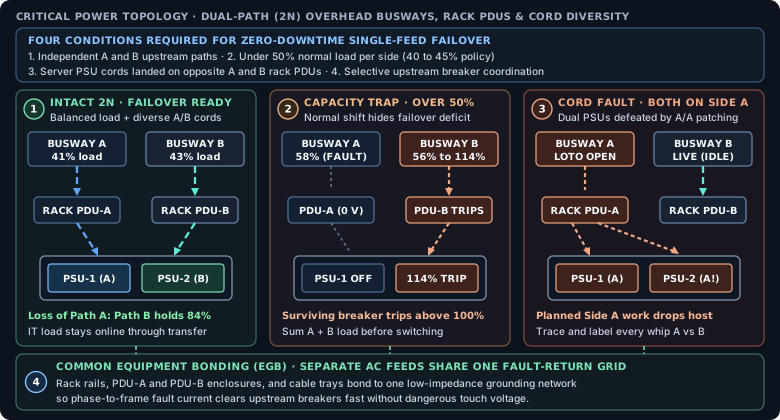
When dual A and B feeds keep a rack online, and when they fail

Three-panel diagram comparing intact 2N A and B rack feeds at 41% and 43% load against an over-50% failover overload trip and a mispatched A/A single-side cord error, above a shared equipment bonding bar.

Dual-corded servers survive a single-feed outage only when Path A and Path B stay independent, each side runs below 50% normal load, power cords land on opposite PDUs, and breakers clear faults selectively over one common equipment ground.

  1. Balanced 2N (41% A, 43% B) with PSU-1 on A and PSU-2 on B carries 84% on one surviving bus.
  2. Running 58% on A and 56% on B looks normal until failover sums to 114% and trips Side B.
  3. Landing both server cords on PDU-A defeats dual power supplies during planned Side A maintenance.
  4. Independent AC power paths still share one bonded equipment ground so fault current clears fast.
Read full plain-text diagram walkthrough

Panel 1 shows Busway A at 41% and Busway B at 43% feeding Rack PDU-A and Rack PDU-B, with Server PSU-1 on A and PSU-2 on B; losing Path A places 84% on Path B without tripping. Panel 2 shows Busway A at 58% and Busway B at 56%, where losing Path A pushes Path B to 114% and trips the surviving breaker. Panel 3 shows both PSU-1 and PSU-2 mistakenly plugged into PDU-A, dropping the host during planned Side A LOTO work. Callout 4 shows Rack rails and both PDU enclosures bonded to one common Equipment Grounding Bar.

Practice with the systems

Move from a definition to a real operating scenario.

Reference entries connect directly to our free six-mission browser simulator and nine self-paced data center courses. Each course is $399 self-paced tuition ($1,600 list, save $1,201), with five open lessons you can read before reserving.

Scope note: Growing, source-backed operational reference built around Rackscale courses and Campus Shift scenarios, with additional networking, electrical safety, reliability, and coolant-chemistry entries added in reviewed batches. It does not claim exhaustive coverage of every vendor term and never replaces adopted codes (NEC, NFPA 70E, ASHRAE), OEM manuals, or site-specific LOTO and switching authorization.