Availability, Mean Time Between Failures (MTBF), and Mean Time To Repair (MTTR)
Plain-English definition
Three reliability metrics that describe how steadily a repairable system stays ready for work. Mean Time Between Failures (MTBF) is the average operating time between breakdowns. Mean Time To Repair (MTTR) is the average time needed to diagnose, fix, and restore service. Inherent availability equals MTBF divided by (MTBF + MTTR).
Why it matters on shift
A high component MTBF is not a promise of multi-year calendar life, and slow repairs quickly erase uptime gains. Waiting two days for an unstocked breaker hurts annual availability far more than minor hardware differences, which is why spare parts, bypasses, and clear procedures matter.
Illustrative operational example
In an illustrative single-path constant-rate model, an assembly with MTBF = 39,996 hours and MTTR = 4 hours reaches inherent availability A = 39,996 / (39,996 + 4) = 0.9999, or 99.99% ('four nines'), equal to roughly 52.6 minutes of unplanned downtime per 365-day year. Lowering MTTR from 4 hours to 1 hour with an on-site spare raises modeled availability to 99.9975%.
Scope, code & safety boundary
Component MTBF reflects a population failure rate during normal useful life rather than wear-out age (such as battery or capacitor end of life), and simple independent-failure math understates risk whenever two paths share a hidden common cause or human switching error.

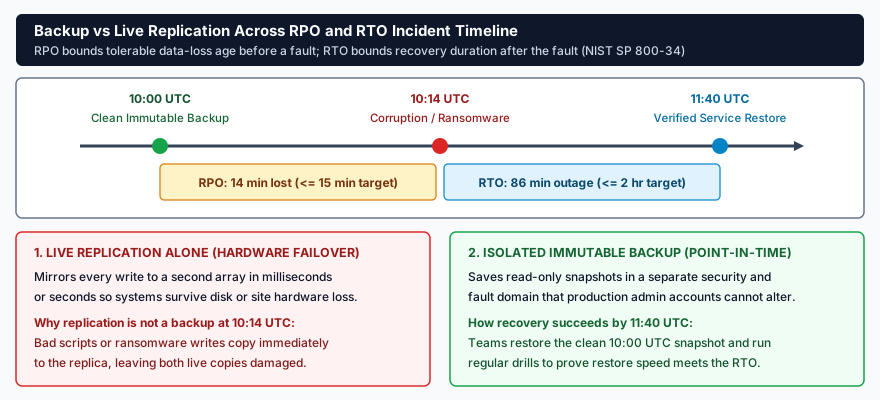
Recovery Point Objective (RPO) bounds how much pre-fault data age can be lost; Recovery Time Objective (RTO) bounds post-fault outage time. Live replication survives hardware loss, while isolated immutable backups recover from logical corruption or ransomware.
Read plain-text walkthrough of this diagram
Incident timeline from 10:00 UTC (clean immutable backup) through 10:14 UTC (corruption or ransomware event, showing a 14-minute data-loss window inside a 15-minute RPO target) to 11:40 UTC (verified service restore after an 86-minute outage inside a 2-hour RTO target). Left comparison card explains that live replication copies bad writes or ransomware immediately to the secondary array. Right card explains that isolated read-only snapshots in a separate security domain allow clean point-in-time rollback when regularly tested.
Related courses & interactive lab practice
Facility, rack & safety foundations
Critical power & dual-path feeds
Shift command, permits & reliability
Practice live readings and switching in "Zero-Downtime UPS Make-Before-Break Wrap" with no login required.
Primary standards & technical references