Approach Temperature (Heat Exchanger and Tower Approach)
Plain-English definition
The closest temperature gap between the leaving cooled fluid and the entering cooling sink across a heat-transfer device, such as leaving tower water minus ambient wet-bulb, leaving dry-cooler water minus ambient dry-bulb, or leaving CDU secondary coolant minus entering facility chilled water.
Why it matters on shift
Because heat flows only across a finite temperature difference and finite surface area, approach temperature can never reach zero; rising approach at constant load is an early warning of fouled plates, scaled tubes, or air-side blockage.
Illustrative operational example
At an illustrative 18.5°C outdoor wet-bulb with a 1.9°C wetted approach, the coldest water leaving an adiabatic pre-cooler is 20.4°C; similarly, a CDU fed 16.0°C facility water with a 5.0°C approach cannot supply secondary coolant colder than 21.0°C.
Scope, code & safety boundary
Tighter (smaller) design approaches require larger heat-exchanger surface area and higher pump or fan pressure drop; compare live approach against OEM commissioning curves at matching load.
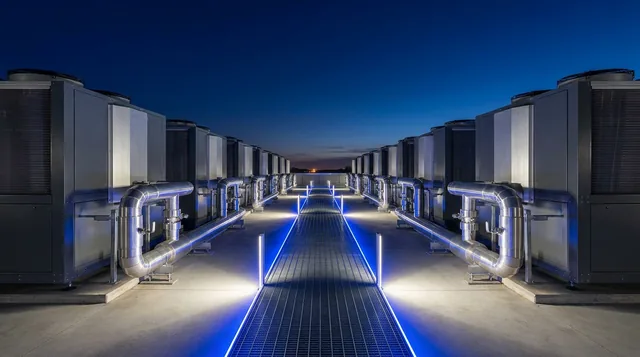
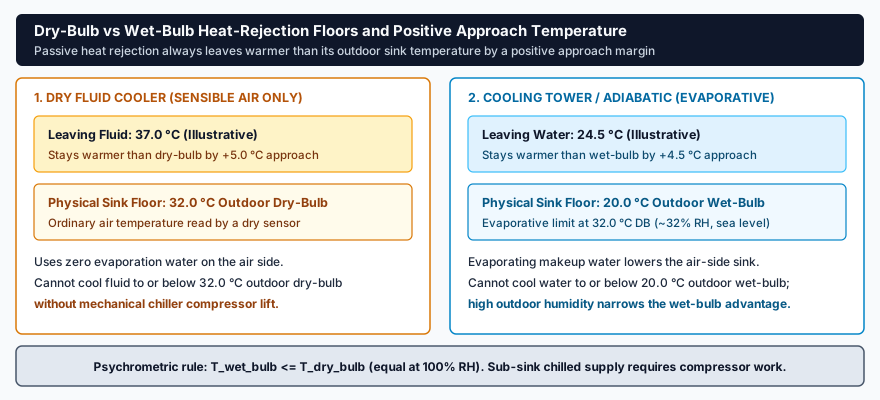
Passive heat-rejection equipment always leaves warmer than its outdoor sink floor by a positive approach temperature: dry coolers approach outdoor dry-bulb, while evaporative towers and adiabatic coolers approach outdoor wet-bulb.
Read plain-text walkthrough of this diagram
Two-column comparison at an illustrative outdoor condition of 32.0 degrees C dry-bulb and 20.0 degrees C wet-bulb (roughly 32% relative humidity at sea level). Column 1 (Dry Fluid Cooler) uses zero air-side evaporation water and is bounded by the 32.0 degrees C dry-bulb floor, leaving at an illustrative 37.0 degrees C (+5.0 degrees C approach). Column 2 (Cooling Tower / Adiabatic Evaporative) evaporates water to lower the air-side sink to the 20.0 degrees C wet-bulb floor, leaving at an illustrative 24.5 degrees C (+4.5 degrees C approach). Neither passive system can cool fluid below its respective sink floor without mechanical chiller compressor work.
Related courses & interactive lab practice
Air, chilled-water & liquid cooling
High-density AI cooling & commissioning
Energy, water & capacity accounting
Practice live readings and switching in "35 kW Hot/Cold Aisle Containment Lab" with no login required.
Primary standards & technical references