Dew-Point Temperature (DP)
Plain-English definition
The exact temperature at which water vapor in a parcel of air becomes saturated and begins condensing into liquid droplets on any solid surface cooled to or below that temperature, assuming constant barometric pressure and moisture content.
Why it matters on shift
Dew point tracks absolute moisture directly regardless of air heating across a rack, making it critical for both preventing sweat on liquid-cooling pipes and honoring upper/lower ASHRAE moisture envelopes.
Illustrative operational example
When Hall D air has an illustrative 18.5°C dew point, supplying 19.5°C secondary coolant leaves only +1.0°C margin, violating a +3.0°C pod guardband (21.5°C minimum coolant supply) meant to prevent manifold sweating.
Scope, code & safety boundary
ASHRAE Chapter 20 Table 1 specifies both lower (-9°C DP) and upper (15°C DP for A1 to A4 recommended) equipment-inlet moisture bounds alongside relative humidity; calibrate hall dew-point transmitters regularly.
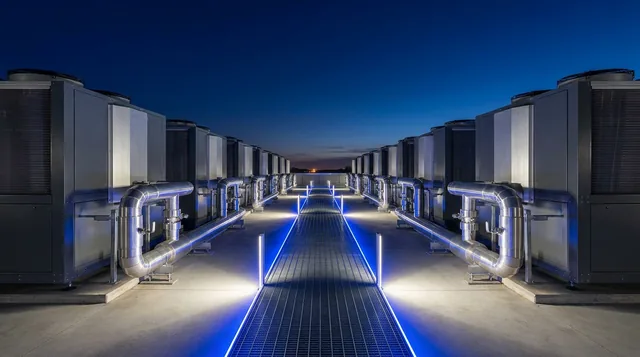
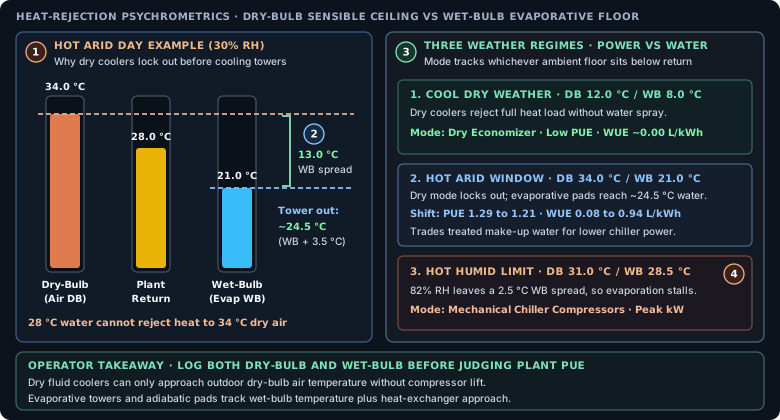
Dry coolers reject heat only down toward outdoor dry-bulb air temperature. Evaporative towers and adiabatic pads can cool water closer to wet-bulb temperature on hot dry days, trading water consumption (WUE) for lower chiller power (PUE).
Read plain-text walkthrough of this diagram
Left chart compares 34.0 degrees Celsius dry-bulb air, 28.0 degrees Celsius plant return water, and 21.0 degrees Celsius wet-bulb temperature at 30% relative humidity (13.0 degrees Celsius wet-bulb spread). Because 28.0 degrees Celsius water is cooler than 34.0 degrees Celsius dry air, dry free cooling locks out, whereas evaporative cooling approaches wet-bulb plus 3.5 degrees Celsius approach (~24.5 degrees Celsius water). Right panel compares Cool Dry weather (12.0 degrees Celsius DB, dry economizer, near-zero water), Hot Arid weather (34.0 degrees Celsius DB / 21.0 degrees Celsius WB, PUE improves from 1.29 to 1.21 while WUE rises from 0.08 to 0.94 L/kWh), and Hot Humid weather (31.0 degrees Celsius DB / 28.5 degrees Celsius WB, evaporation stalls and chillers carry full mechanical lift).
Related courses & interactive lab practice
High-density AI cooling & commissioning
Air, chilled-water & liquid cooling
Practice live readings and switching in "35 kW Hot/Cold Aisle Containment Lab" with no login required.
Primary standards & technical references