Dry-Bulb Temperature (DB)
Plain-English definition
The sensible temperature of air measured by an ordinary thermometer shielded from direct radiation and moisture. Dry-bulb temperature reflects sensible heat content alone without indicating how much water vapor the air holds or how far evaporation could cool a wetted surface.
Why it matters on shift
Dry-bulb temperature sets the lower physical limit for purely dry sensible heat rejection (an un-wetted outdoor coil must leave return water strictly warmer than ambient dry-bulb) and serves as the primary temperature axis at IT intakes.
Illustrative operational example
On an illustrative 36.0°C dry-bulb desert afternoon, a dry outdoor fluid cooler cannot cool 24.0°C return chilled water; attempting dry coil flow would heat the loop rather than cool it.
Scope, code & safety boundary
Outdoor weather sensors mounted near hot generator exhaust or dark roofs read artificially high dry-bulb values; verify aspirated weather-station placement before trusting economizer lockouts.
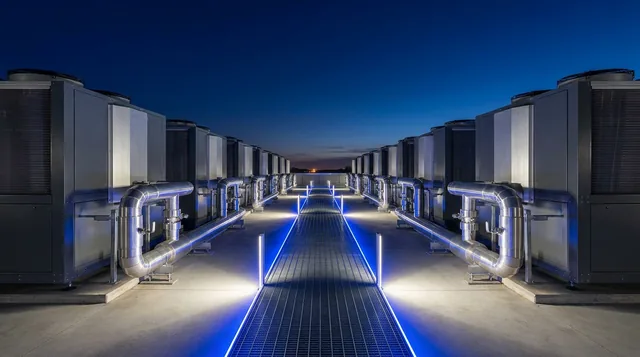
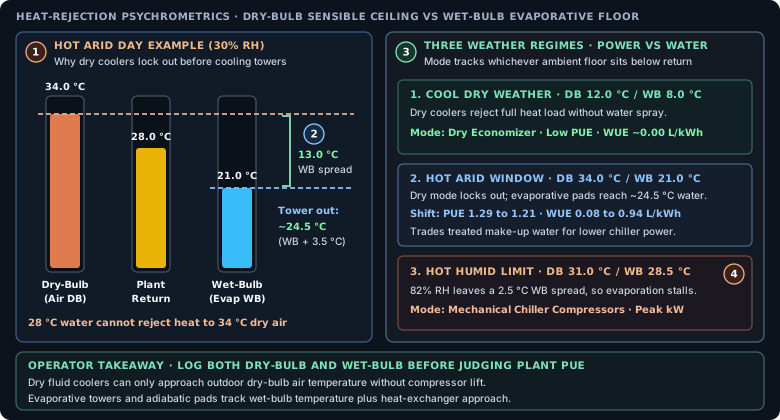
Dry coolers reject heat only down toward outdoor dry-bulb air temperature. Evaporative towers and adiabatic pads can cool water closer to wet-bulb temperature on hot dry days, trading water consumption (WUE) for lower chiller power (PUE).
Read plain-text walkthrough of this diagram
Left chart compares 34.0 degrees Celsius dry-bulb air, 28.0 degrees Celsius plant return water, and 21.0 degrees Celsius wet-bulb temperature at 30% relative humidity (13.0 degrees Celsius wet-bulb spread). Because 28.0 degrees Celsius water is cooler than 34.0 degrees Celsius dry air, dry free cooling locks out, whereas evaporative cooling approaches wet-bulb plus 3.5 degrees Celsius approach (~24.5 degrees Celsius water). Right panel compares Cool Dry weather (12.0 degrees Celsius DB, dry economizer, near-zero water), Hot Arid weather (34.0 degrees Celsius DB / 21.0 degrees Celsius WB, PUE improves from 1.29 to 1.21 while WUE rises from 0.08 to 0.94 L/kWh), and Hot Humid weather (31.0 degrees Celsius DB / 28.5 degrees Celsius WB, evaporation stalls and chillers carry full mechanical lift).
Related courses & interactive lab practice
Air, chilled-water & liquid cooling
Energy, water & capacity accounting
Practice live readings and switching in "35 kW Hot/Cold Aisle Containment Lab" with no login required.
Primary standards & technical references