Electrostatic Discharge (ESD) Safe Handling
Plain-English definition
The practice of equalizing static electricity between a person, their work surface, and a grounded chassis before touching exposed circuit boards. Electrostatic discharge (ESD) is a tiny spark of static charge that people often cannot feel, yet it can damage memory sticks, network cards, processors, and optical transceivers.
Why it matters on shift
Walking across a floor or peeling plastic wrap can build thousands of volts on your body, while human fingers typically feel a static zap only around 2,000 to 3,000 V. Sensitive server chips can suffer immediate failure or hidden latent damage below 100 V (Human Body Model), causing intermittent errors weeks later.
Illustrative operational example
In an illustrative memory swap following ANSI/ESD S20.20 practices, a technician checks their wrist strap at a footwear-and-strap tester, clips to the cabinet's unpainted ESD bonding point, and stages Dual In-Line Memory Modules (DIMMs) on a grounded dissipative mat inside static-shielding bags. A built-in 1 megaohm series resistor inside the wrist cord drains static slowly while limiting shock current.
Scope, code & safety boundary
Never wear an ESD wrist strap while working on or near exposed live AC or DC power circuits, and never treat room humidity control as a substitute for personal ESD grounding. Hold cards by their edges, keep spares inside metallized static-shielding bags until installation, and follow OEM service guides. Dedicated bench-to-rack hardware craft belongs to the planned Rack and Fiber Craft candidate course (not published).

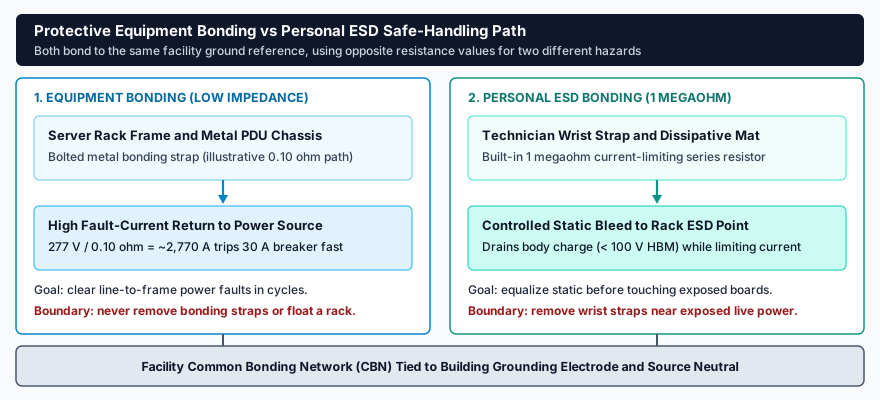
Both paths connect to the same facility Common Bonding Network, using opposite resistance values: below 0.1 ohm on metal frames to trip breakers fast during power faults, versus 1 megaohm in ESD wrist cords to drain static slowly while limiting shock current.
Read plain-text walkthrough of this diagram
Two-column comparison connected to the facility Common Bonding Network (CBN). Column 1 (Equipment Bonding) shows a server rack frame and metal PDU chassis bonded via an illustrative 0.10 ohm metal strap so a 277 V fault passes roughly 2,770 A back to the source and trips a 30 A breaker quickly; never remove bonding straps or float a rack. Column 2 (Personal ESD Bonding) shows a technician wrist strap and dissipative mat with a built-in 1 megaohm current-limiting resistor that drains static charge below 100 V (Human Body Model) to the rack ESD point; always remove wrist straps before working near exposed live power.
Related courses & interactive lab practice
Facility, rack & safety foundations
High-density AI cooling & commissioning
Practice live readings and switching in "NOC, Spine-Fiber & White-Space Walkdown" with no login required.
Primary standards & technical references